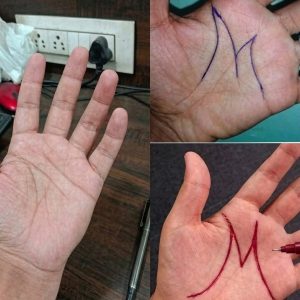
The idea that the lines on a person’s palm can reveal personality traits or life tendencies has existed for centuries, most commonly through the practice of palmistry. Although it is not supported by scientific evidence, it remains a source of fascination because it offers a symbolic way to reflect on identity and human behavior. Within this tradition, the three main lines—the life line, head line, and heart line—are often interpreted as representing vitality, intellect, and emotion. When viewed together, they can sometimes form patterns that resemble letters, with the “M” shape being one of the most widely discussed.
The “M” is not a deliberate marking but a natural result of how these lines develop on an individual’s palm. Despite this, palmistry traditions have assigned meaning to it, often describing it as a symbol of intuition, awareness, and inner strength. Those who believe in its significance suggest that people with this formation may be particularly perceptive, able to notice details or emotional undercurrents that others might overlook. It is also associated, in symbolic terms, with determination and resilience, suggesting a person who approaches challenges with both instinct and careful thought.
One reason the “M” attracts attention is its perceived rarity, which adds to its sense of uniqueness. In palmistry interpretations, it is sometimes linked to a balance between logic and intuition. Rather than relying solely on analytical thinking or emotional reaction, individuals with this marking are thought to integrate both when making decisions. While this idea is not scientifically validated, it resonates with many people because it reflects qualities that are generally seen as valuable in everyday life, such as awareness, adaptability, and thoughtful judgment.
A further layer of interpretation involves the Simian line, where the head and heart lines merge into a single line across the palm. In palmistry, this feature is sometimes associated with intense focus and a blending of emotional and rational thought. When this formation contributes to the appearance of an “M,” it is believed in symbolic traditions to amplify traits such as concentration and emotional depth. Although modern research does not support these claims as indicators of personality, the symbolism continues to be explored as a way of reflecting on human complexity.
Another aspect of palmistry considers which hand displays the “M.” The dominant hand is often associated with learned behavior and conscious choices, while the non-dominant hand is thought to represent innate tendencies. From this perspective, an “M” on the non-dominant hand may be interpreted as a natural inclination toward certain traits, while on the dominant hand it may symbolize developed qualities shaped by experience. This distinction mirrors broader psychological ideas about the interaction between inherited traits and life experience, even though the palmistry interpretation itself is symbolic rather than scientific.
Beyond individual traits, the “M” is also sometimes linked in palmistry to communication skills, leadership, and interpersonal awareness. These interpretations suggest a person who can navigate social situations with confidence and empathy, understanding both spoken and unspoken dynamics. However, these ideas are part of a symbolic framework rather than measurable reality.
Ultimately, the fascination with the “M” on the palm reflects a broader human tendency to seek meaning in patterns. Even without scientific grounding, such interpretations can encourage reflection and curiosity about oneself. Rather than offering predictions, they function as metaphors that invite people to think about their strengths, behaviors, and ways of relating to the world.