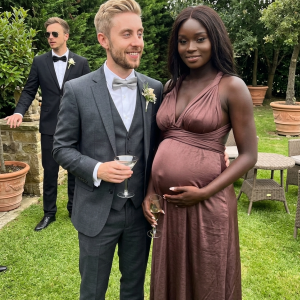
In the early days of social media, long before short-form videos and influencer culture dominated daily life, two young creatives—Jamie Perkins and Nikki Perkins—found each other across a digital divide. Their connection wasn’t rooted in proximity or shared circles, but in curiosity, attraction, and the thrill of discovering someone who felt unexpectedly familiar. Nikki, a South Sudanese-Australian model, and Jamie, an Australian cinematographer and musician, first exchanged messages in the late 2000s. What began casually soon deepened, fueled by shared creativity, mutual admiration, and an unmistakable spark.
Their bond grew into marriage and parenthood, forming a multicultural family that attracted attention both locally and online. Long before family vlogging became a global phenomenon, Jamie and Nikki documented moments of their lives—not as a marketing strategy, but as a personal archive. Jamie’s cinematic proposal video went viral, and their wedding video followed, captivating viewers with the authenticity of their love story, the energy of youth, and the beauty of an interracial partnership.
As their family expanded, so did their online presence. Their shared YouTube channel, Jamie and Nikki, offered glimpses into everyday life: pregnancy updates, children’s milestones, travel adventures, and quiet domestic moments. The content resonated because it felt genuine, unscripted, and affectionate—a rare portrayal of family life that celebrated difference rather than glossing over it. Fans were drawn not just to their story, but to the warmth, honesty, and complementary dynamics between Nikki and Jamie.
Despite the growth of their audience, Jamie often emphasized that the videos were never about fame. They were a memory-keeping project—a way to capture their journey as a young couple. Nikki, however, navigated the pressures of public attention differently. Raised in a household valuing privacy and modesty, the sudden visibility—modeling, videos, and viral attention—was unfamiliar territory. Even simple moments, like her father being recognized on public transit, underscored how dramatically life had shifted.
The scrutiny intensified over time. Nikki faced harsh online commentary about her appearance, personality, and choices, while Jamie encountered biases as a white father to biracial daughters. On one occasion, a medical professional questioned his parental connection to their first daughter, Ava—a stark reminder that public exposure amplifies personal challenges and societal prejudices alike.
As their platform expanded, so did the pressures of maintaining it. The channel, initially a private diary, became a public stage where viewers judged marital dynamics, parenting, and decisions based on glimpses of edited content. Private disagreements, normal stress, and personal growth all became harder to navigate under constant observation.
By 2019, Jamie and Nikki had separated privately, prioritizing the well-being of their daughters while shielding themselves from public scrutiny. Their separation was only confirmed in 2023, surprising longtime viewers who had assumed the couple was simply taking a break from filming. The quiet dissolution revealed the gap between perception and reality, highlighting the complexities of living and loving under a public lens.
Their story may have concluded as a marriage, but it remains significant. It showcased multicultural family life, inspired viewers with moments of joy, and demonstrated how online narratives reveal only fragments of truth. Jamie and Nikki’s journey underscores that relationships—no matter how ideal they may appear—carry challenges invisible to others, especially when amplified by public attention.
Ultimately, their story reflects love, identity, and the pressures of visibility. It reminds us that behind every curated video lies a deeper reality: real love, real struggle, and real transformation often unfold far from the camera. What endures is their shared legacy as parents, creators, and individuals who navigated an intimate life in an undeniably public world.